

Parashah: “VaYishlach” (and he sent) GENESIS: 32:3-36:43
We see in this week's parashah that Ya'akov is on his way home to Beth-El. He comes to his “encounter” with his brother Esav. It is a time of tension for him, as we know, he “stole” from him the blessing. Or was it really theft? Remember that Esau “sold” or “traded” his birthright for a “bowl of red lentils.” Was it really theft? Perhaps we can say that Jacob took advantage of his brother's worldliness and carnal nature; some say it was “deceit,” but was it really? Esau and Jacob made a deal: Esau's birthright for a bowl of soup. It would be like exchanging a Mercedes-Benz 2025 for a used bicycle. Isaac gives Jacob the firstborn birthright, and Esau gets the leftovers. He threatens to kill Jacob.
Jacob and Esau departed as enemies. Time has passed, and Jacob has had much to think about. He feels perhaps guilt and remorse for having taken advantage of his brother. YHVH has blessed him with wives and children, the future “Am Yisrael.” He now feels a need for “compensation” for wrongdoing. Therefore, to “ease” the angry spirit of Esau (so Jacob thinks), he sends him gifts of cattle, hoping to “cool him off.”
But let's think about that: is compensation necessary for wrongdoing? The Torah says YES, it is. If I borrow your camera, and I drop it, break it, I will owe you another camera. If you and I have a wrestling match, and I accidentally break your hand, I would have to pay the doctor's bill, etc. This is the true meaning of “An eye for an eye, and a tooth for a tooth.
”
Just for precautionary measures, he separates his family, “just in case” Esau is still on the war-path. Can we blame Jacob? Esau is coming to meet his brother with 400 armed men! Oi Vey, why with 400 men? Armed too! Could this be an attack? Or friendship rekindled? Jacob is “Schvitzen” (sweating). But now he is about to encounter “GOD” in the flesh.
He says, “Adonai, help!” Hey God, remember your promise? To keep me safe? You aren't going back on your promise, are you? YHVH responds with a personal visit that night. A very interesting visit.
The Torah says that during the night “a man wrestled with him until the break of day” Ya'akov didn't know it then, but he was wrestling with “HaMalach Elohim (The Angel of the LORD). How do we wrestle with God today? Ever think of that? Good question! We all “wrestle” with God in trying to understand his ways in our lives, some of his ways are uncomfortable, his ways might be testings, trials, hardships, and trying to understand how these events will work for “good” in our lives.
Trying to find HIS perfect will for our lives is one way, dealing with “flesh vs spirit” issues is another way. Trying to get HIM to follow “us”, instead of “us” following HIM, is another way. Just seeing where we fit in with his plan for our lives is a wrestling match, yet “Jacob prevails,” he says, “Bless me before you go!” YHVH says to him, “Your name will no longer be Ya'akov, but Yisrael.”
It is also interesting that both the angel and Jacob ask for names. First, the angel asks for his name, then Jacob asks for a name. Remember that in the book of Exodus, Moshe asks God his name also. The same answer is given: “Why do you ask me my name?”
We are so different from God, since we are finite beings, our names (at times) describe who we are. We are, in a sense, boxed in by names. We tend to act according to our names. Yet, God is very different. Why is that?
Adonai-Elohim can not be “boxed in” by a name, He is “beyond names” He told Moshe; “Ehye Asher Ehye” (I am who I am) which is not really answering the question, He is telling him “I have existed, I exist, I will exist” Now that answer was not given to Jacob (now Israel) Adonai answered his question with a question; “Why ask me my name?”
Today, we have many, many names that describe who God is. The most common three have been and are: Elohim, El, and Yah. When we read the names of prophets, they contain either of the two “El” or “Yah”. We also see that Israel states, “I have seen the face of God and have lived (Panim el Panim) But why “faces?” Why not “face?” One could say “13 faces” or “attributes” which describe who Elohim is.
Jacob finds himself alone, facing, as he thinks, imminent danger from being slaughtered by his brother Esau. He puts his family in hiding, he sends gifts of cattle to Esau to maybe “soften him up,” he might think. Now comes a wrestling match. Jacob is at his wits' end; it is only he and Elohim. Elohim comes to visit him in the form of the “Angel of YHVH.” The Torah says that he “wrestled with a man all night,” and Jacob did not relent; he did not give up the wrestling match until the Angel touched his thigh, thus wounding him. Then comes the interesting part: the Angel gives him a blessing, and he changes his name from “Jacob” to “Israel.”
From “trickster, deceiver” to “straight to G-d” When we see the name “Yisrael” it can be divided into two parts; “Yasher- El” (straight to G-d) the name “Yisrael” also contains the acronyms of the patriarchs and matriarchs who played a part in forming the nation of Israel; “YI” Yitzchak “S” Sarah “R” Rachel and Riv’kah “AE” Abraham “L” Leah.
Israel now says something interesting: “Vayikra Ya’akov shem haMakom Peniel Ki ra’iti Elohim Panim Et Panim” (and Jacob called the name of that place “Peniel” (face of God) for I have seen Elohim “faces to faces”.What is interesting is that here, the word “face” is used in the singular and in the plural. Peni-el, (face of God) in the ancient paleo-Hebrew letters, the word is symbolized as “mouth, life, action, God, Leader” in gematria, the word “Peniel” adds up to 171, (the unique, one (echad) G-d is perfect) when we add 1+7+1 = 9. “9” is the number of “emet” (truth) and “Yeshua” also has that title.
But “Panim El Panim” (faces to faces) is somewhat strange, or is it? How many faces does God have? Or does he even have a face, since he is “spirit”? In one way, he “has a face” in physical form as the “Angel of YHVH, Jacob saw him, Abraham also saw him. But now, “faces?” What could that mean? Here is one idea;
He has the “Panim Rachamim” (faces of Mercy) or “mercies” (endless mercy!”) He has the “face of forgiveness” the “face of longsuffering” the “face of patience” yet the faces of “punishment” “chastisement” “judgement and condemnation” for unrepentant sinners, the faces of “joy” and “wrath” of “happiness and sadness” “approval and disappointment” the face of a “God who listens and responds” the list could go on. I am thinking of Exodus 34, when Moses asks to "see God" and he lists his atributes. We could possibly call the atributes "faces."
We can imagine how he is feeling inside when we are in obedience or disobedience. Another way of seeing “Panim El Panim” is “Faces God Faces” because “El” is one of G-d’s names. (the shortest one)
Israel has now surrendered to the will of YHVH. He meets Esau, and the meeting is touching; no hard feelings. And Israel renders homage before his brother, a very penitent attitude. They fall upon each other’s necks and kiss and weep! Israel made amends; he shared with his brother Esau a portion of his blessings. Making amends is very important. There is such a thing as “restoration” (of relationships) and “restitution” (for things, perhaps stolen, destroyed, etc.)
Israel and his children go to Shechem, where we see that “Dinah is raped.” Yet we must ask; "What business did Dinah have in wandering off and mixing with the 'daughters of the land?" Being that Shechem was a pagan Canaanite city. Was she looking for trouble? The brothers take drastic action and retaliate, destroying the city. I would say very “rash” and “violent “action. But why would they want to associate with people who are idol worshipers? The case being, they had no business there in the first place. If you are in the wrong place and at the wrong time, you're bound to get “bit”.
However, Jacob (Israel) moves on and arrives at Beth-El, where God appeared to him when he left his home in Beersheva, where he envisioned the Heavenly Ladder. He builds an altar there and calls it “El-Elohei-Israel” (God, the God of Israel). He stands firm in his convictions, yet his sons have a lot to learn. There are probably many times when we act rashly and do not do things God's way, thus embarrassing our relationship with YHVH. I think we all have a bit of carnal Esau and Jacob in us all. Yet, like the Ladder that reached heaven, we are to advance up the ladder step by step, rung by rung, hanging on to Yeshua all the way.
Israel/Jacob moves on; he nears "Efrata" (now known as Bethlehem), "Beit-Lechem" (House of Bread). This is where Rachel gives birth to Benjamin and then dies in childbirth. Now, here is a lesson to learn. Rachel had stolen the household idols from the house of Laban, her father. We don't know the reason why. One possible reason is that she believed that having the idols in her possession would guarantee the blessings for her new family, or that it would have been impossible for Laban to track down Jacob without "divination" through those idols or "household gods." These are just possibilities, in accordance with popular belief and tradition in Mesopotamia.
When Laban caught up with Jacob, he accused him of stealing "his gods!" Jacob did not know that Rachel had stolen them. Jacob responded:
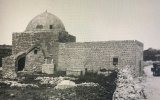
"May that person not live" (if the gods were found in that person's possession). Jacob's words came to pass. Rachel died in childbirth and was buried alone in a tomb near Bethlehem. It is still there today.
Lessons to be learned: We all wrestle with God, trying to figure out his ways in our lives. Let us submit to his perfect will in our lives. Make peace with people whom we have offended. Restoration and restitution are BIBLICAL MEANS. Sometimes, the only thing we can do is offer a sincere "I am sorry." Be careful with our words, they just might come to pass. Let us go back to our Beth-El, the "House of God." He will meet us there; he is already waiting.
Rachel's Tomb on the road to Bethlehem (Pic: 1930s)
We see in this week's parashah that Ya'akov is on his way home to Beth-El. He comes to his “encounter” with his brother Esav. It is a time of tension for him, as we know, he “stole” from him the blessing. Or was it really theft? Remember that Esau “sold” or “traded” his birthright for a “bowl of red lentils.” Was it really theft? Perhaps we can say that Jacob took advantage of his brother's worldliness and carnal nature; some say it was “deceit,” but was it really? Esau and Jacob made a deal: Esau's birthright for a bowl of soup. It would be like exchanging a Mercedes-Benz 2025 for a used bicycle. Isaac gives Jacob the firstborn birthright, and Esau gets the leftovers. He threatens to kill Jacob.
Jacob and Esau departed as enemies. Time has passed, and Jacob has had much to think about. He feels perhaps guilt and remorse for having taken advantage of his brother. YHVH has blessed him with wives and children, the future “Am Yisrael.” He now feels a need for “compensation” for wrongdoing. Therefore, to “ease” the angry spirit of Esau (so Jacob thinks), he sends him gifts of cattle, hoping to “cool him off.”
But let's think about that: is compensation necessary for wrongdoing? The Torah says YES, it is. If I borrow your camera, and I drop it, break it, I will owe you another camera. If you and I have a wrestling match, and I accidentally break your hand, I would have to pay the doctor's bill, etc. This is the true meaning of “An eye for an eye, and a tooth for a tooth.
”
Just for precautionary measures, he separates his family, “just in case” Esau is still on the war-path. Can we blame Jacob? Esau is coming to meet his brother with 400 armed men! Oi Vey, why with 400 men? Armed too! Could this be an attack? Or friendship rekindled? Jacob is “Schvitzen” (sweating). But now he is about to encounter “GOD” in the flesh.
He says, “Adonai, help!” Hey God, remember your promise? To keep me safe? You aren't going back on your promise, are you? YHVH responds with a personal visit that night. A very interesting visit.
The Torah says that during the night “a man wrestled with him until the break of day” Ya'akov didn't know it then, but he was wrestling with “HaMalach Elohim (The Angel of the LORD). How do we wrestle with God today? Ever think of that? Good question! We all “wrestle” with God in trying to understand his ways in our lives, some of his ways are uncomfortable, his ways might be testings, trials, hardships, and trying to understand how these events will work for “good” in our lives.
Trying to find HIS perfect will for our lives is one way, dealing with “flesh vs spirit” issues is another way. Trying to get HIM to follow “us”, instead of “us” following HIM, is another way. Just seeing where we fit in with his plan for our lives is a wrestling match, yet “Jacob prevails,” he says, “Bless me before you go!” YHVH says to him, “Your name will no longer be Ya'akov, but Yisrael.”
It is also interesting that both the angel and Jacob ask for names. First, the angel asks for his name, then Jacob asks for a name. Remember that in the book of Exodus, Moshe asks God his name also. The same answer is given: “Why do you ask me my name?”
We are so different from God, since we are finite beings, our names (at times) describe who we are. We are, in a sense, boxed in by names. We tend to act according to our names. Yet, God is very different. Why is that?
Adonai-Elohim can not be “boxed in” by a name, He is “beyond names” He told Moshe; “Ehye Asher Ehye” (I am who I am) which is not really answering the question, He is telling him “I have existed, I exist, I will exist” Now that answer was not given to Jacob (now Israel) Adonai answered his question with a question; “Why ask me my name?”
Today, we have many, many names that describe who God is. The most common three have been and are: Elohim, El, and Yah. When we read the names of prophets, they contain either of the two “El” or “Yah”. We also see that Israel states, “I have seen the face of God and have lived (Panim el Panim) But why “faces?” Why not “face?” One could say “13 faces” or “attributes” which describe who Elohim is.
Jacob finds himself alone, facing, as he thinks, imminent danger from being slaughtered by his brother Esau. He puts his family in hiding, he sends gifts of cattle to Esau to maybe “soften him up,” he might think. Now comes a wrestling match. Jacob is at his wits' end; it is only he and Elohim. Elohim comes to visit him in the form of the “Angel of YHVH.” The Torah says that he “wrestled with a man all night,” and Jacob did not relent; he did not give up the wrestling match until the Angel touched his thigh, thus wounding him. Then comes the interesting part: the Angel gives him a blessing, and he changes his name from “Jacob” to “Israel.”
From “trickster, deceiver” to “straight to G-d” When we see the name “Yisrael” it can be divided into two parts; “Yasher- El” (straight to G-d) the name “Yisrael” also contains the acronyms of the patriarchs and matriarchs who played a part in forming the nation of Israel; “YI” Yitzchak “S” Sarah “R” Rachel and Riv’kah “AE” Abraham “L” Leah.
Israel now says something interesting: “Vayikra Ya’akov shem haMakom Peniel Ki ra’iti Elohim Panim Et Panim” (and Jacob called the name of that place “Peniel” (face of God) for I have seen Elohim “faces to faces”.What is interesting is that here, the word “face” is used in the singular and in the plural. Peni-el, (face of God) in the ancient paleo-Hebrew letters, the word is symbolized as “mouth, life, action, God, Leader” in gematria, the word “Peniel” adds up to 171, (the unique, one (echad) G-d is perfect) when we add 1+7+1 = 9. “9” is the number of “emet” (truth) and “Yeshua” also has that title.
But “Panim El Panim” (faces to faces) is somewhat strange, or is it? How many faces does God have? Or does he even have a face, since he is “spirit”? In one way, he “has a face” in physical form as the “Angel of YHVH, Jacob saw him, Abraham also saw him. But now, “faces?” What could that mean? Here is one idea;
He has the “Panim Rachamim” (faces of Mercy) or “mercies” (endless mercy!”) He has the “face of forgiveness” the “face of longsuffering” the “face of patience” yet the faces of “punishment” “chastisement” “judgement and condemnation” for unrepentant sinners, the faces of “joy” and “wrath” of “happiness and sadness” “approval and disappointment” the face of a “God who listens and responds” the list could go on. I am thinking of Exodus 34, when Moses asks to "see God" and he lists his atributes. We could possibly call the atributes "faces."
We can imagine how he is feeling inside when we are in obedience or disobedience. Another way of seeing “Panim El Panim” is “Faces God Faces” because “El” is one of G-d’s names. (the shortest one)
Israel has now surrendered to the will of YHVH. He meets Esau, and the meeting is touching; no hard feelings. And Israel renders homage before his brother, a very penitent attitude. They fall upon each other’s necks and kiss and weep! Israel made amends; he shared with his brother Esau a portion of his blessings. Making amends is very important. There is such a thing as “restoration” (of relationships) and “restitution” (for things, perhaps stolen, destroyed, etc.)
Israel and his children go to Shechem, where we see that “Dinah is raped.” Yet we must ask; "What business did Dinah have in wandering off and mixing with the 'daughters of the land?" Being that Shechem was a pagan Canaanite city. Was she looking for trouble? The brothers take drastic action and retaliate, destroying the city. I would say very “rash” and “violent “action. But why would they want to associate with people who are idol worshipers? The case being, they had no business there in the first place. If you are in the wrong place and at the wrong time, you're bound to get “bit”.
However, Jacob (Israel) moves on and arrives at Beth-El, where God appeared to him when he left his home in Beersheva, where he envisioned the Heavenly Ladder. He builds an altar there and calls it “El-Elohei-Israel” (God, the God of Israel). He stands firm in his convictions, yet his sons have a lot to learn. There are probably many times when we act rashly and do not do things God's way, thus embarrassing our relationship with YHVH. I think we all have a bit of carnal Esau and Jacob in us all. Yet, like the Ladder that reached heaven, we are to advance up the ladder step by step, rung by rung, hanging on to Yeshua all the way.
Israel/Jacob moves on; he nears "Efrata" (now known as Bethlehem), "Beit-Lechem" (House of Bread). This is where Rachel gives birth to Benjamin and then dies in childbirth. Now, here is a lesson to learn. Rachel had stolen the household idols from the house of Laban, her father. We don't know the reason why. One possible reason is that she believed that having the idols in her possession would guarantee the blessings for her new family, or that it would have been impossible for Laban to track down Jacob without "divination" through those idols or "household gods." These are just possibilities, in accordance with popular belief and tradition in Mesopotamia.
When Laban caught up with Jacob, he accused him of stealing "his gods!" Jacob did not know that Rachel had stolen them. Jacob responded:
"May that person not live" (if the gods were found in that person's possession). Jacob's words came to pass. Rachel died in childbirth and was buried alone in a tomb near Bethlehem. It is still there today.
Lessons to be learned: We all wrestle with God, trying to figure out his ways in our lives. Let us submit to his perfect will in our lives. Make peace with people whom we have offended. Restoration and restitution are BIBLICAL MEANS. Sometimes, the only thing we can do is offer a sincere "I am sorry." Be careful with our words, they just might come to pass. Let us go back to our Beth-El, the "House of God." He will meet us there; he is already waiting.
Rachel's Tomb on the road to Bethlehem (Pic: 1930s)
