

A STUDY ON HANUKKAH, WHAT IS IT ALL ABOUT? (From the evening of December 14 - ending December 22nd)
“And it was at Jerusalem the Feast of the Dedication (Hanukkah), and it was winter, and Yeshua (Jesus) walked in the temple in Solomon's porch” (John 10:22,23). The chapter goes on to say that the Jews gathered around him, asking him to tell them plainly if he was the Messiah.
Hanukkah was an important festival, important enough for our Messiah to be at the temple and answer questions. The meaning of the word “Hanukkah” is “dedication”. In order to understand this better, we need to go back and read 2 Chronicles 7:8-10. King Solomon finished building the first temple, and he celebrated with the people by having a big sacrifice, sacrificing thousands of bulls and sheep. He invited the people, and they shared in the festivity. He celebrated for 8 days, during the time of Sukkot (Feast of Tabernacles), on the 8th day, “Hoshanah Raba,” he blessed the people and sent them home. A lot happened after that time; the priests and much of the people took their eyes off the LORD, and went into idolatry.
Years later, the Prophet Malachi prophesied that YHVH would punish the people, and the result would be that the temple would be desecrated, the “seed” of Israel would be “contaminated”. You can read this in Malachi 1:6; 2:1,2,8,9. The Prophet Daniel was more precise. He had visions of what would happen in the future.
The visions of Daniel in chapter 8 had to do with “two” end-time periods. One, the end time before the first coming of Messiah Yeshua, and the second, the end time before the second coming of Messiah, which is still in the future. In Chapter 8:5, the prophet sees a “he goat” (Greece) and a “ram” (Persia). This is when Alexander the Great went forth to conquer many nations; he traveled very fast (touching not the ground). This happened around 330 B.C. He went from West (Greece) towards the East (nations East of Greece), these nations included Persia, Egypt, Syria, and Israel (Judea).
The prophet mentions the “horn that was broken” (Alexander's death) and from that, 4 other horns came out (four generals took over). (Daniel 8:8). “Ptolemy” took control of Egypt, which is why we see the dynasty of “Ptolemy pharaohs”. Queen Cleopatra was a “Ptolemy”. Seleucid took control over Syria. From Seleucid, came the “little horn that waxed great”. This was the rise of Antiochus (Daniel 8:9). First, there was Antiochus III, and afterward, Antiochus IV (Epiphanes). It was Antiochus Epiphanes who wreaked Havoc in Judea, was a tyrant, a murderer who was satanically controlled. He proclaimed himself “Zeus incarnate,” thus the title “Epiphanes.” An epiphany is a carnal likeness of a god. But what happened to Judea before the rise of Antiochus?
Alexander had introduced “Hellenism” to the conquered world. Judea could either accept the new Greek ways or reject them. Most Israelites rejected them; they stayed Torah observant and worshiped YHVH. Some accepted the new Greek ways, new Greek style clothing, music, philosophy, gymnastics, drama, language, etc... Under Alexander, and even under the first Antiochus (III), Judeans had a choice, either accept or reject; it didn't really matter, but when Antiochus III died, and his son Antiochus IV came to power, all changed.
Everyone had to convert to Hellenism, accept Antiochus as supreme ruler and “god” manifested in human form, or die. No longer could they study Torah; the scrolls were destroyed, and circumcision of males was a capital offense. So life was “hell” for all of Israel that did not convert or accept Hellenism, and accept Antiochus as “Zeus incarnate”.
On the 25th of the Hebrew month of Kislev, 167 B.C, Antiochus invades the temple in Jerusalem and desecrates it. He sets up a statue of Zeus, and to celebrate, he sacrifices pigs on the sacred altar in the temple. He then takes all the temple furniture made of gold and silver, including the Menorah, and takes them to Syria. The temple is now bare, and desecrated, and now dedicated to Zeus and pagan sacrifices. (Daniel 8:11-12).
The next thing that Antiochus did was to replace the Judean “Onias”, the high priest, and put his own brother “Jason” as priest instead of Onias. Jason started promoting “Zeus worship and pig sacrifices” throughout Judea. He went to the city of Modin, where the priest Mattathias lived with his five sons: John, Jonathan, Judah, Simon, and Eleazar. This is where the resistance started.
Jason had sent an officer to offer Mattathias riches and honor, if only he would set the example and offer pig sacrifices to Zeus. The officer was not prepared for the reaction of Mattathias. With a loud voice, he responded;
“Though all the nations that are under the king's dominion obey him and fall away from the religion of their fathers, and give consent to his commandments, yet will I and my sons and my brethren walk in the covenant of our fathers. God forbid that we should forsake the Torah and the ordinances. We will not harken to the king's words to go from our religion, either on the right hand or the left!” (1st Book of Maccabees)
After hearing these words, another priest standing nearby offered to sacrifice, in exchange for gold and silver. When the priest tried to go forward, Mattathias took a sword and slew him there, and also slew the officer in charge. Now, Mattathias and his sons were wanted criminals in the eyes of Antiochus. Mattathias and his sons had to flee the city, and they went into the hills of Judea to hide.
Other faithful Judeans heard what Mattathias had done and went out to be with him and his sons, thus forming a small army. Yet what did they have? Perhaps a few spears, a few knives, pitchforks, and not many swords. Judeans from all classes in society went to join him and his sons. There, out in the wilderness, they prepared for battle. They would strike out against Antiochus and his trained Greek-Syrian forces. They would fight with guerrilla warfare tactics. They knew the terrain; the Greeks didn't.
This reminds us of the Revolutionary War in the United States, when the 13 colonies were under British rule. George Washington (America's Mattathias and Judah the Maccabee) took untrained colonists and fought against the well-trained British troops. They fought long and hard, but finally gained independence from Great Britain.
Antiochus now knew that Mattathias and his small army were serious. Mattathias was old, and he died during this war. He left his eldest son, Judah, to take command. His surname “Maccabee” comes from the Hebrew/Aramaic word “Makabah” which means “Hammer”, so his whole name in Hebrew “Y'hudah Makavi” is telling us “My God YAH is my hammer”. With the strength and blessings of God, Y'hudah and his army went forth to fight against Antiochus and his armies.
Antiochus sent out four generals: Apollonius, Georgias, Seron, and Nicanor. The strength of these armies was probably 100,000 or more. Yet Judah fought them all (guerrilla style strike and run, strike and hide, ambush, etc...) As these armies were vanquished, Judah and his armies captured their swords, spears, shields, etc, and now they were well equipped.
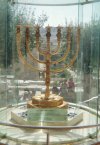
Needless to say, Judah pushed forward and finally drove the Greek-Syrians out of Judea. He and his army retook Jerusalem. The temple was in shambles, the altar desecrated with swine blood and guts, and the Temple emptied of its treasures. Judah and his men got to work; they tore down the pagan altar and built an altar to YHVH. He went and “brought in new vessels, the candlestick (Menorah), the table of Shewbread, and the altar of incense, which were made of gold” (Josephus, the complete works, pg. 393).
Another question is, where did they “bring in new vessels from?” Did they have them made? Did Judah send a detachment or a regiment of soldiers to Antioch to recapture the temple furniture and bring them back to Jerusalem? We know that Antioch was the headquarters of Antiochus, and he probably took the golden temple furniture to Antioch. That is a possibility.
Judah and his men went to work and made the temple like new again, re-lit the menorah, and made a “feast of dedication” for 8 days, just like in the days of Solomon, when he dedicated the first temple for eight days. Judah offered sacrifices on the newly built brazen altar just like Solomon did. This also happened on the same day, 25th of Kislev, 164 B.C., three years after it had been desecrated. This year, the 25th of Kislev was Monday, December 15th.
Some believe that there was just one clay flask or jar of oil left in the temple. The belief is that this flask of oil was only enough for one day of light, but it lasted for eight days. The problem with this is that it was never written down in history that it actually happened. The Jewish historian, Josephus, never mentioned it. Now, could it have happened? Sure, anything is possible. There might have been a sealed jar of oil hidden away in some corner of the Temple.
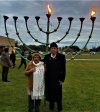
Today, we still celebrate this time of year. Many people have a special 9-branched menorah called a “Hanukkiah”. This is used especially for this time. The middle branch is called the “Shamash” (the helper) from this middle branch, which holds and candle or oil with a wick; the other candles are lit each night for 8 nights. As Messianic Jewish believers, we see the symbolism in the middle branch as “Yeshua,” who is the “Light of the World,” and we are the “little lights”; we get our light from Messiah Yeshua. He even said, “Ye are the light of the world. (Matt 5:14-16)
One way we can look at the 9 branches of the Hanukkiah is in the following manner: We can see 9 aspects of the faith; “Teshuvah” (repentance), “Tzedakah” (charity and giving), “Mitzvot” (good works), “Emunah” (faith),“Yeshua” (Salvation) “Mishpochah” (family) “Ahavah” (love) “HaTorah” (God's Word) “Israel” (the Holy Land) are all inter-related. And we can also add “Chen” (faith) because by “faith” we are saved, not of works, lest any man should boast.
Many also “spin the dreidel,” which is a four-sided top, with the letters N, G, H, S, (but in Hebrew), which symbolize, “Nez, Gadol, Haya, Sham” (A great miracle happened there). What was the miracle? That a small army of about 10,000 men fought against a superior army of 100,000 or more, yet not through the might of swords and spears, but through the might and power of YHVH, they won and achieved victory.
These 4 letters, when added up in gematria, = 358; the word “Mashiach” (Messiah) also adds up to the sum of 358. Mashiach gave the victory. He also gives us the victory in our lives against sin. We can think of “Dedication” at this time of year to re-dedicate our lives to Messiah Yeshua, to serve him, and keep on serving him, and to be “lights” in dark places. Our work and service in Messiah Yeshua ends on earth when we are called home, and even in heaven, we will continue to serve and see His LIGHT forever.
Another name for Hanukkah is the "Festival of Lights" (Hag HaUrim) It is also believed that around the time of Hanukkah, Mary became pregnant with our Messiah Yeshua, and carried within her the "Light of the World" and gave birth, perhaps towards the end of September or early October. (during the Feast of Tabernacles)
Families celebrate Hanukkah in different forms. They get together, as many people get together during the Christmas season, they share their love, make potato latkes (fried potatoes with flour and egg mixture), play games (with the dreidel), give small gifts, many times food gifts; packets or boxes of imported teas or coffees, chocolates,
The most important is lighting the special “Hanukkiah.” They come in all sizes and forms, some traditional, others abstract. One creative way of having the “9-lights” is purchasing 8 small jars of fragrance candles in glass jars and 1 large jar. different fragrance spices, like pumpkin spice, vanilla, almond butter, etc. These are 3 inches tall by 2 inches wide. Then the middle jar is larger, it measures 5 ½ inches tall by 3 inches wide (around). The middle jar is lit as the “Shamash,” the Helper. And each night, the jars on each side are lit.
The first night is the shamash and the end jar-candle, the second night, the middle jar-candle and two more, etc. This creates the lights of Hanukkah and a lovely fragrance in the living room. Some people use an electric menorah in the window.
The last point I would like to share is that the word “Hanukkah” means “dedication”. It comes from the Hebrew letters which are “Chet”, “Nun”, and “Kaf”. In English, we would see “Ch”, “n”, and “k.”
The base word in Hebrew is “Chanakh,” which has the meaning of “to initiate, discipline, dedicate, train up, and habituate. From this verb comes the noun “Hanukkah” In the ancient Hebrew symbolism, the Paleo-Hebrew letters symbolize “The fence gives an anointed life” or “The fence of life that brings anointing” The “Fence” being the Torah and the “Living Torah” which is Yeshua, They “surround” us and give us protection from the ways of the world.
How do we apply “Chanakh” and “Hanukkah” in our lives today? Since the temple in Jerusalem is no more, our own bodies are now the “Temple of the Holy Spirit”. At this time of year, we might look inwardly and re-dedicate ourselves to the LORD, by discipling ourselves in Torah study, doing Mitzvoth (good works), training up others to study and understand God’s Word, and putting it into action. Make Torah study a “habit” (habituate) every day in our lives.
We shouldn’t have to wait for Hanukkah to re-dedicate our lives to Adonai; we should do this every waking morning of every day, but this is the time we should really look at our lives with a fine-tooth comb, because the enemy “HaSatan” is the Antiochus who wants to see us defeated, yet Yeshua has won the war. Baruch HaShem!!
HAPPY 8 DAYS AND NIGHTS OF HANUKKAH. (a cold first night of Hanukkah, quite a few years ago)
“And it was at Jerusalem the Feast of the Dedication (Hanukkah), and it was winter, and Yeshua (Jesus) walked in the temple in Solomon's porch” (John 10:22,23). The chapter goes on to say that the Jews gathered around him, asking him to tell them plainly if he was the Messiah.
Hanukkah was an important festival, important enough for our Messiah to be at the temple and answer questions. The meaning of the word “Hanukkah” is “dedication”. In order to understand this better, we need to go back and read 2 Chronicles 7:8-10. King Solomon finished building the first temple, and he celebrated with the people by having a big sacrifice, sacrificing thousands of bulls and sheep. He invited the people, and they shared in the festivity. He celebrated for 8 days, during the time of Sukkot (Feast of Tabernacles), on the 8th day, “Hoshanah Raba,” he blessed the people and sent them home. A lot happened after that time; the priests and much of the people took their eyes off the LORD, and went into idolatry.
Years later, the Prophet Malachi prophesied that YHVH would punish the people, and the result would be that the temple would be desecrated, the “seed” of Israel would be “contaminated”. You can read this in Malachi 1:6; 2:1,2,8,9. The Prophet Daniel was more precise. He had visions of what would happen in the future.
The visions of Daniel in chapter 8 had to do with “two” end-time periods. One, the end time before the first coming of Messiah Yeshua, and the second, the end time before the second coming of Messiah, which is still in the future. In Chapter 8:5, the prophet sees a “he goat” (Greece) and a “ram” (Persia). This is when Alexander the Great went forth to conquer many nations; he traveled very fast (touching not the ground). This happened around 330 B.C. He went from West (Greece) towards the East (nations East of Greece), these nations included Persia, Egypt, Syria, and Israel (Judea).
The prophet mentions the “horn that was broken” (Alexander's death) and from that, 4 other horns came out (four generals took over). (Daniel 8:8). “Ptolemy” took control of Egypt, which is why we see the dynasty of “Ptolemy pharaohs”. Queen Cleopatra was a “Ptolemy”. Seleucid took control over Syria. From Seleucid, came the “little horn that waxed great”. This was the rise of Antiochus (Daniel 8:9). First, there was Antiochus III, and afterward, Antiochus IV (Epiphanes). It was Antiochus Epiphanes who wreaked Havoc in Judea, was a tyrant, a murderer who was satanically controlled. He proclaimed himself “Zeus incarnate,” thus the title “Epiphanes.” An epiphany is a carnal likeness of a god. But what happened to Judea before the rise of Antiochus?
Alexander had introduced “Hellenism” to the conquered world. Judea could either accept the new Greek ways or reject them. Most Israelites rejected them; they stayed Torah observant and worshiped YHVH. Some accepted the new Greek ways, new Greek style clothing, music, philosophy, gymnastics, drama, language, etc... Under Alexander, and even under the first Antiochus (III), Judeans had a choice, either accept or reject; it didn't really matter, but when Antiochus III died, and his son Antiochus IV came to power, all changed.
Everyone had to convert to Hellenism, accept Antiochus as supreme ruler and “god” manifested in human form, or die. No longer could they study Torah; the scrolls were destroyed, and circumcision of males was a capital offense. So life was “hell” for all of Israel that did not convert or accept Hellenism, and accept Antiochus as “Zeus incarnate”.
On the 25th of the Hebrew month of Kislev, 167 B.C, Antiochus invades the temple in Jerusalem and desecrates it. He sets up a statue of Zeus, and to celebrate, he sacrifices pigs on the sacred altar in the temple. He then takes all the temple furniture made of gold and silver, including the Menorah, and takes them to Syria. The temple is now bare, and desecrated, and now dedicated to Zeus and pagan sacrifices. (Daniel 8:11-12).
The next thing that Antiochus did was to replace the Judean “Onias”, the high priest, and put his own brother “Jason” as priest instead of Onias. Jason started promoting “Zeus worship and pig sacrifices” throughout Judea. He went to the city of Modin, where the priest Mattathias lived with his five sons: John, Jonathan, Judah, Simon, and Eleazar. This is where the resistance started.
Jason had sent an officer to offer Mattathias riches and honor, if only he would set the example and offer pig sacrifices to Zeus. The officer was not prepared for the reaction of Mattathias. With a loud voice, he responded;
“Though all the nations that are under the king's dominion obey him and fall away from the religion of their fathers, and give consent to his commandments, yet will I and my sons and my brethren walk in the covenant of our fathers. God forbid that we should forsake the Torah and the ordinances. We will not harken to the king's words to go from our religion, either on the right hand or the left!” (1st Book of Maccabees)
After hearing these words, another priest standing nearby offered to sacrifice, in exchange for gold and silver. When the priest tried to go forward, Mattathias took a sword and slew him there, and also slew the officer in charge. Now, Mattathias and his sons were wanted criminals in the eyes of Antiochus. Mattathias and his sons had to flee the city, and they went into the hills of Judea to hide.
Other faithful Judeans heard what Mattathias had done and went out to be with him and his sons, thus forming a small army. Yet what did they have? Perhaps a few spears, a few knives, pitchforks, and not many swords. Judeans from all classes in society went to join him and his sons. There, out in the wilderness, they prepared for battle. They would strike out against Antiochus and his trained Greek-Syrian forces. They would fight with guerrilla warfare tactics. They knew the terrain; the Greeks didn't.
This reminds us of the Revolutionary War in the United States, when the 13 colonies were under British rule. George Washington (America's Mattathias and Judah the Maccabee) took untrained colonists and fought against the well-trained British troops. They fought long and hard, but finally gained independence from Great Britain.
Antiochus now knew that Mattathias and his small army were serious. Mattathias was old, and he died during this war. He left his eldest son, Judah, to take command. His surname “Maccabee” comes from the Hebrew/Aramaic word “Makabah” which means “Hammer”, so his whole name in Hebrew “Y'hudah Makavi” is telling us “My God YAH is my hammer”. With the strength and blessings of God, Y'hudah and his army went forth to fight against Antiochus and his armies.
Antiochus sent out four generals: Apollonius, Georgias, Seron, and Nicanor. The strength of these armies was probably 100,000 or more. Yet Judah fought them all (guerrilla style strike and run, strike and hide, ambush, etc...) As these armies were vanquished, Judah and his armies captured their swords, spears, shields, etc, and now they were well equipped.
Needless to say, Judah pushed forward and finally drove the Greek-Syrians out of Judea. He and his army retook Jerusalem. The temple was in shambles, the altar desecrated with swine blood and guts, and the Temple emptied of its treasures. Judah and his men got to work; they tore down the pagan altar and built an altar to YHVH. He went and “brought in new vessels, the candlestick (Menorah), the table of Shewbread, and the altar of incense, which were made of gold” (Josephus, the complete works, pg. 393).
Another question is, where did they “bring in new vessels from?” Did they have them made? Did Judah send a detachment or a regiment of soldiers to Antioch to recapture the temple furniture and bring them back to Jerusalem? We know that Antioch was the headquarters of Antiochus, and he probably took the golden temple furniture to Antioch. That is a possibility.
Judah and his men went to work and made the temple like new again, re-lit the menorah, and made a “feast of dedication” for 8 days, just like in the days of Solomon, when he dedicated the first temple for eight days. Judah offered sacrifices on the newly built brazen altar just like Solomon did. This also happened on the same day, 25th of Kislev, 164 B.C., three years after it had been desecrated. This year, the 25th of Kislev was Monday, December 15th.
Some believe that there was just one clay flask or jar of oil left in the temple. The belief is that this flask of oil was only enough for one day of light, but it lasted for eight days. The problem with this is that it was never written down in history that it actually happened. The Jewish historian, Josephus, never mentioned it. Now, could it have happened? Sure, anything is possible. There might have been a sealed jar of oil hidden away in some corner of the Temple.
Today, we still celebrate this time of year. Many people have a special 9-branched menorah called a “Hanukkiah”. This is used especially for this time. The middle branch is called the “Shamash” (the helper) from this middle branch, which holds and candle or oil with a wick; the other candles are lit each night for 8 nights. As Messianic Jewish believers, we see the symbolism in the middle branch as “Yeshua,” who is the “Light of the World,” and we are the “little lights”; we get our light from Messiah Yeshua. He even said, “Ye are the light of the world. (Matt 5:14-16)
One way we can look at the 9 branches of the Hanukkiah is in the following manner: We can see 9 aspects of the faith; “Teshuvah” (repentance), “Tzedakah” (charity and giving), “Mitzvot” (good works), “Emunah” (faith),“Yeshua” (Salvation) “Mishpochah” (family) “Ahavah” (love) “HaTorah” (God's Word) “Israel” (the Holy Land) are all inter-related. And we can also add “Chen” (faith) because by “faith” we are saved, not of works, lest any man should boast.
Many also “spin the dreidel,” which is a four-sided top, with the letters N, G, H, S, (but in Hebrew), which symbolize, “Nez, Gadol, Haya, Sham” (A great miracle happened there). What was the miracle? That a small army of about 10,000 men fought against a superior army of 100,000 or more, yet not through the might of swords and spears, but through the might and power of YHVH, they won and achieved victory.
These 4 letters, when added up in gematria, = 358; the word “Mashiach” (Messiah) also adds up to the sum of 358. Mashiach gave the victory. He also gives us the victory in our lives against sin. We can think of “Dedication” at this time of year to re-dedicate our lives to Messiah Yeshua, to serve him, and keep on serving him, and to be “lights” in dark places. Our work and service in Messiah Yeshua ends on earth when we are called home, and even in heaven, we will continue to serve and see His LIGHT forever.
Another name for Hanukkah is the "Festival of Lights" (Hag HaUrim) It is also believed that around the time of Hanukkah, Mary became pregnant with our Messiah Yeshua, and carried within her the "Light of the World" and gave birth, perhaps towards the end of September or early October. (during the Feast of Tabernacles)
Families celebrate Hanukkah in different forms. They get together, as many people get together during the Christmas season, they share their love, make potato latkes (fried potatoes with flour and egg mixture), play games (with the dreidel), give small gifts, many times food gifts; packets or boxes of imported teas or coffees, chocolates,
The most important is lighting the special “Hanukkiah.” They come in all sizes and forms, some traditional, others abstract. One creative way of having the “9-lights” is purchasing 8 small jars of fragrance candles in glass jars and 1 large jar. different fragrance spices, like pumpkin spice, vanilla, almond butter, etc. These are 3 inches tall by 2 inches wide. Then the middle jar is larger, it measures 5 ½ inches tall by 3 inches wide (around). The middle jar is lit as the “Shamash,” the Helper. And each night, the jars on each side are lit.
The first night is the shamash and the end jar-candle, the second night, the middle jar-candle and two more, etc. This creates the lights of Hanukkah and a lovely fragrance in the living room. Some people use an electric menorah in the window.
The last point I would like to share is that the word “Hanukkah” means “dedication”. It comes from the Hebrew letters which are “Chet”, “Nun”, and “Kaf”. In English, we would see “Ch”, “n”, and “k.”
The base word in Hebrew is “Chanakh,” which has the meaning of “to initiate, discipline, dedicate, train up, and habituate. From this verb comes the noun “Hanukkah” In the ancient Hebrew symbolism, the Paleo-Hebrew letters symbolize “The fence gives an anointed life” or “The fence of life that brings anointing” The “Fence” being the Torah and the “Living Torah” which is Yeshua, They “surround” us and give us protection from the ways of the world.
How do we apply “Chanakh” and “Hanukkah” in our lives today? Since the temple in Jerusalem is no more, our own bodies are now the “Temple of the Holy Spirit”. At this time of year, we might look inwardly and re-dedicate ourselves to the LORD, by discipling ourselves in Torah study, doing Mitzvoth (good works), training up others to study and understand God’s Word, and putting it into action. Make Torah study a “habit” (habituate) every day in our lives.
We shouldn’t have to wait for Hanukkah to re-dedicate our lives to Adonai; we should do this every waking morning of every day, but this is the time we should really look at our lives with a fine-tooth comb, because the enemy “HaSatan” is the Antiochus who wants to see us defeated, yet Yeshua has won the war. Baruch HaShem!!
HAPPY 8 DAYS AND NIGHTS OF HANUKKAH. (a cold first night of Hanukkah, quite a few years ago)



 in Knoxville.
 our service. Hopefully our web person will post in the next day or two Pastor Dan’s Sermon for all to listen.
 Requests portion of our service for prayers of healing and comfort to those who have no extended family members visiting or are completely alone this week. Yes, there are so many.
  for => Gaza Envelope